
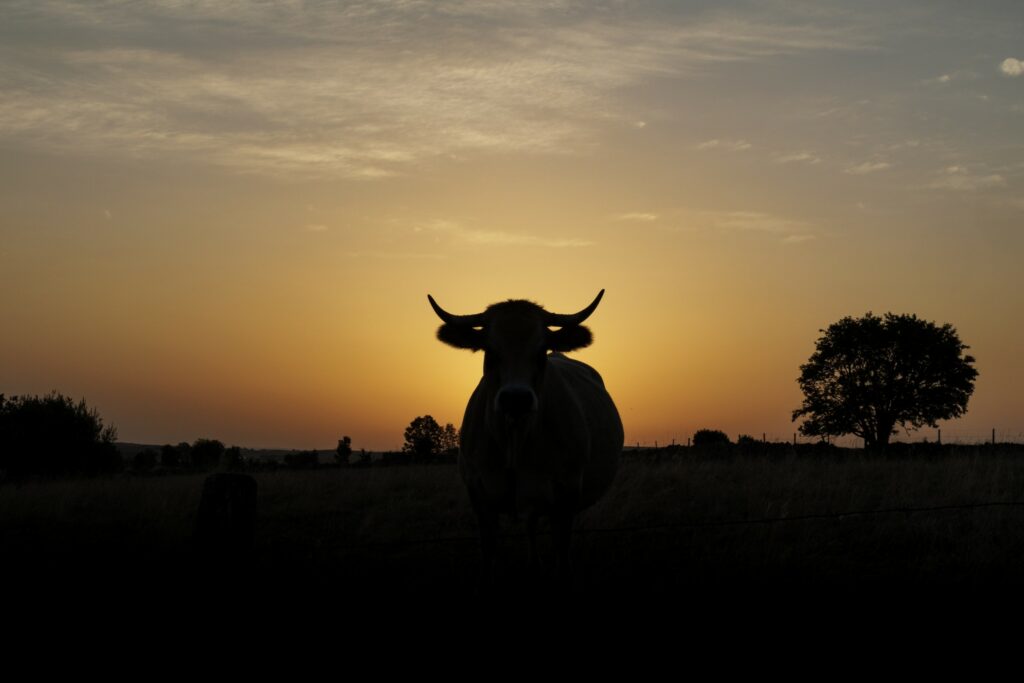
It was 6:20 a.m., 38°C forecast for the afternoon, and the Aubrac cows weren’t budging an inch. They sat there, on the plateau, in the raking light that turned their wheat-coloured coats an almost unreal amber. The ground was already burning under my feet. Down below, Nasbinals was still asleep — 500 inhabitants, a Romanesque bell tower, and a crossroads of paths that photographers, pilgrims and hikers have shared for decades.
This is the story of that photography trip in the Aubrac: the spots I scouted, the mistakes I made in the heatwave, the tables where I ate aligot, and everything you need to know about the PHOT’Aubrac festival to make the most of it.
TL;DR: Nasbinals is the photographic heart of the Aubrac — a volcanic plateau, vast pastures, golden light and basalt waterfalls. Every mid-September, the PHOT’Aubrac festival draws 25,000 visitors to 50+ free exhibitions. In summer, the heatwave turns the grasses to gold and creates unique light from dawn onwards.
The Aubrac in summer: a plateau that reinvents itself in the heat
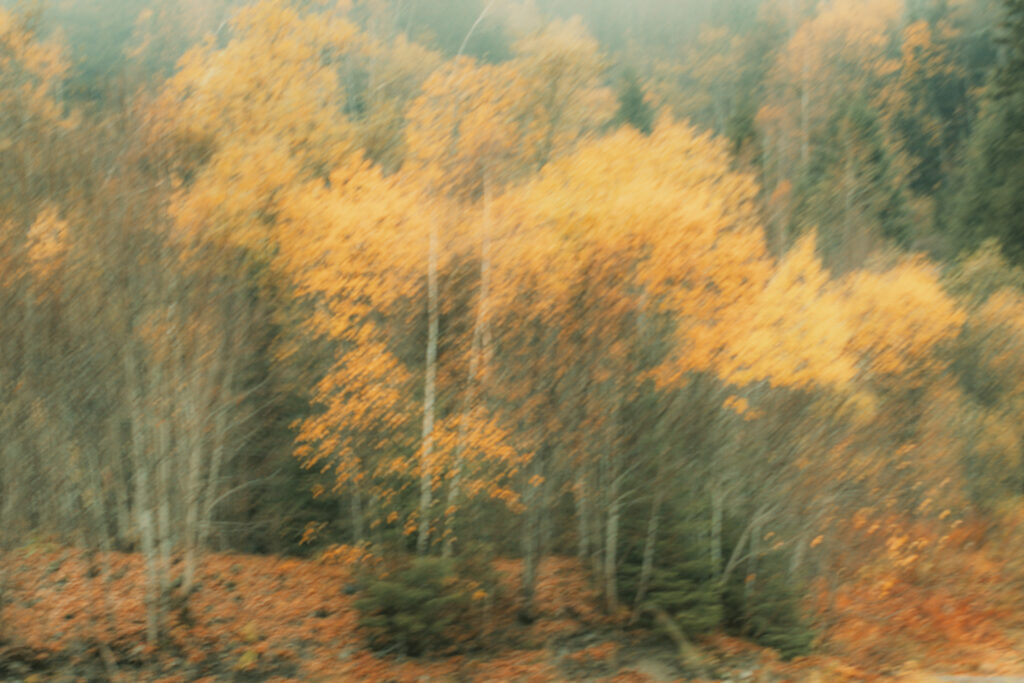
Many people still think of the Aubrac as a spring or autumn destination. That’s a mistake. The volcanic Aubrac plateau covers 173,000 hectares straddling the Aveyron, Lozère and Cantal departments (aubrac-lozere.com), between 1,000 and 1,400 m in altitude. In summer, the heatwave turns its high pastures into a landscape with the tones of an African savannah — dry, golden, dramatic.
I crossed the Aubrac for the first time in May, on a rainy, fog-bound outing. I went back in August under 38°C. They are two different planets. The summer light on the short grass reveals the geology of the plateau in a way that the spring green hides completely. The basalt rocks break through the surface, the paths turn to dust, and the horizon becomes immense.
The volcanic light of the Aubrac owes its character to the altitude and the transparency of the air: even at midday in the height of the heatwave, it doesn’t cut the way lowland light does. It warms, it gilds, it stretches the shadows of the herds across 10 metres of meadow.
The Aubrac cows are the other subject of choice. Wheat-coloured coat shading into caramel, lyre-shaped horns, a nonchalant gaze. They go up to the summer pastures between May and October, and in August they seek the shade of the rare trees and gather near the watering points. This behaviour creates natural, photogenic concentrations that you won’t find in spring, when they’re scattered.
The heatwave imposes a constraint that photo guides rarely mention: the heat creates mirages between 11 a.m. and 4 p.m. On the flat roads of the plateau, distant herds literally float above the tarmac. It’s an optical artefact, but it’s a usable photographic effect if you work with a telephoto lens and fine manual focus.
To work in these conditions without missing shots because of your settings, having the right camera settings makes a real difference, especially in extreme heat when fatigue sets in fast.
My 5 photo spots around Nasbinals
Five sites within 15 km of Nasbinals cover every photographic register: water, volcanic rock, 360° panoramas, wildlife and the clean lines of roads. I made several return trips to each one during this stay. Here’s what I took away from them.
1. The Déroc waterfall
The Déroc waterfall is 33 metres high (aubrac-lozere.com) and plunges into a cave of basalt columns formed during the eruptions of the Massif Central. It’s one of the rare sites in France where you can photograph a waterfall from inside a natural cavity, with the hexagonal geometric columns in the foreground.
Access from the D987 towards Malbouzon, park on the verge, then 20 minutes on foot along an easy trail. Best time: early morning, when the light strikes the basalt cliff and the cave is in shadow. That light/shadow contrast gives depth to the columns. At midday it’s flat and uninteresting. Bring a tripod — the cave is dark, long exposures are a must.

2. The Lac des Salhiens
The Lac des Salhiens is a dark, deep, silent glacial lake. In calm weather, the surface becomes a perfect mirror. I was there at 6:30 a.m. one morning during the heatwave: not a breath of wind, perfect reflections, and the raking light turned the water copper. In summer, the surface develops golden reflections you’ll never see in April.
No particular facilities, no refreshment stand, almost no one. That’s its advantage. Plan a composition with the grassy banks to give scale to the mirror.
3. The Lac aux Moines
The Lac aux Moines is smaller, but the composition is naturally built in: a stone house, a lone tree, still water. It’s a classic framing that works well at blue hour, when the cold light gives the whole scene a monastic atmosphere. It’s not the wildest spot on the plateau, but it’s the one that yields the most easily readable images for social media.
4. The Truc de Fortunio
The Truc de Fortunio is the panoramic summit of the area. A 360° view over the whole Aubrac plateau, no trees, no obstacles. The climb from Nasbinals is accessible, even in sandals if you’re not carrying too much. It’s the spot to favour for late summer sunsets, when the sky runs through some twenty different colours in 40 minutes.
From this summit, I counted three different herds visible at once with the naked eye on my climb at 7 p.m. The cattle density of the Aubrac in summer pasture is such that, from a high point, the herds are as much part of the landscape composition as the relief itself.
5. The Malbouzon–Nasbinals road
The road itself is a spot. Clean lines between the pastures, dry-stone ruins, wildflowers along the verge, herds that sometimes cross without warning. I spent more than an hour parked on the roadside working the vanishing lines and perspective. No need to walk: the best of this spot is found from the verge with a 70-200mm.
The 5 spots compared
| Spot | Distance from Nasbinals | Best time | Difficulty | Photo interest |
|---|---|---|---|---|
| Déroc waterfall | 8 km (D987 towards Malbouzon) | Early morning (7–9 a.m.) | Easy | ★★★★★ |
| Lac des Salhiens | 5 km (lakes road) | Sunrise | Easy | ★★★★☆ |
| Lac aux Moines | 3 km (roadside) | Blue hour | Easy | ★★★☆☆ |
| Truc de Fortunio | 4 km (from Nasbinals) | Sunset | Moderate | ★★★★★ |
| Malbouzon road (D987) | 0–8 km | Morning / Evening | Easy | ★★★★☆ |
The PHOT’Aubrac festival: when the plateau becomes an open-air gallery
Created in 2003, PHOT’Aubrac is one of the largest nature photography festivals in France. Every mid-September it draws more than 25,000 visitors over 4 days around 50 free exhibitions (otnasbinals.fr). The 2025 edition runs from 18 to 21 September.
What sets PHOT’Aubrac apart from other photo festivals is the nature of the exhibition venues. Mountain farms, barns, spaces that don’t open the rest of the year. The exhibiting photographers aren’t only well-known names: many are regional authors or scientists documenting the plateau’s biodiversity. The themes lean towards climate change, species extinction, landscapes in transition. This isn’t a decorative festival.
The villages involved spread across the whole area: Nasbinals is the epicentre, but Aubrac, Marchastel, Saint-Urcize and Laguiole take part too. 80 local volunteers and farmers host the festival on their properties — and that’s what gives it its character, genuinely different from a festival in a conference hall.
A practical tip: come on Friday or Saturday morning. On Sunday afternoon, some exhibitions are mobbed and traffic on the small roads becomes difficult. If you’re combining the festival with landscape photography, block out Friday for the natural spots and the weekend for the exhibitions — the morning light will be calmer, without the cars.
More information on the programme and venues: photaubrac.com
Aligot, burons and Aubrac tables: where to eat in Nasbinals?
In Nasbinals, aligot isn’t just one dish among others: it’s the dish. It’s a potato purée whipped with fresh Aubrac tome cheese, worked with a ladle until it turns stringy and elastic, almost alive on the plate. If you’ve never had it, be prepared to be surprised by the texture.
I ordered it twice in three days. The first time to understand it. The second to confirm it was as good as I remembered. Aligot is eaten hot, straight out of the pot, with Aubrac beef or a truffade depending on the place.
Three tables worth noting in the village and its surroundings:
Hôtel-Restaurant La Route d’Argent: in the heart of the village, open 7 days a week, it’s the most convenient address for early risers. Aligot, truffade, grilled Aubrac beef. No fuss, no waiting list during the week.
Restaurant Les Sentiers de l’Aubrac: mostly frequented by pilgrims passing through on the GR65. A good address for a classic aligot, grilled beef and a chestnut-cake dessert. Relaxed atmosphere, fair prices.
Le Buron du Ché: the atmosphere is that of a converted buron (a mountain shepherd’s hut), rustic without overdoing it. Located near the Déroc waterfall, which makes it a logical stop after a morning in the field. The charcuterie and local cheeses round off the main course nicely.

Truffade, an alternative to aligot made with potatoes and fresh tome cheese pan-fried together, is less well known outside the region — it’s often the one that surprises regulars the most. Cured charcuterie and an aged Aubrac tome close the meal properly.
Sleeping in Nasbinals: between pilgrims and photographers
The accommodation on offer in Nasbinals is built for two audiences who rub shoulders without resembling one another: GR65 pilgrims passing through for a night, and hikers or photographers staying several days. This duality guarantees affordable prices and an unpretentious atmosphere.
La Bastide Nasbinals (3-star rated, made up of Le Bastide and La Randonnée) is the most complete establishment in the village. It also offers guided photography stays, which makes it a logical base for an organised Aubrac photography trip.
Hôtel La Route d’Argent has the advantage of being open all year round and accessible to early risers who want to head out for golden hour without crossing anyone in the corridor. A detail that matters when your alarm goes off at 5:45 a.m.
The gîtes d’étape (walkers’ lodges) are numerous, designed for GR65 hikers, and often available by the night. They are functional, clean and sufficient if you spend most of your days outside.
One important point: book early in summer, and even earlier if you’re coming during PHOT’Aubrac in September. The village is small, the accommodation is limited, and the festival draws 25,000 people in 4 days.
Nasbinals on the Camino de Santiago: the Via Podiensis crosses the plateau
Nasbinals lies on the GR65, the Via Podiensis, between Le Puy-en-Velay and Saint-Jean-Pied-de-Port. This historic route is 750 km in total (podiensis.com). Nasbinals is stage 5 from Aumont-Aubrac, and stage 6 leads from Nasbinals to Saint-Chély-d’Aubrac, a section listed as a UNESCO World Heritage Site (tourisme-aveyron.com).
What I hadn’t anticipated before this trip: the pilgrims are part of Nasbinals’s photographic landscape just as much as the cows. Walking poles, the scallop shell tied to the rucksack, silhouettes moving through the morning mist. They’re unexpected human encounters for a landscape photography trip, and some of my best images from this stay include them.
The Romanesque church of Nasbinals, built in the 11th and 12th centuries, is the starting point of stage 6. It’s also a photographic subject in its own right, especially at blue hour when the village’s artificial light contrasts with the sky.
FAQ
What is the best season to photograph the Aubrac?
The Aubrac offers two strong seasons for landscape photography. Spring (May–June) gives green pastures, flowers and soft light. Summer (July–August) turns the plateau into a golden savannah under the heatwave, with dramatic light from dawn. September combines the end of the summer pasture, the first morning mists and the PHOT’Aubrac festival (25,000 visitors, according to otnasbinals.fr).
How do you reach the Déroc waterfall from Nasbinals?
From Nasbinals, take the D987 towards Malbouzon. The car park is on the verge after about 8 km. The waymarked trail is a 20-minute walk on easy terrain. The waterfall is 33 m high (according to aubrac-lozere.com) and is photographed from inside the basalt cave below. A tripod is essential for the long exposures in the cave.
Is the PHOT’Aubrac festival free?
Yes, the 50+ exhibitions of the PHOT’Aubrac festival are entirely free and open access. Created in 2003, the festival gathers more than 25,000 visitors over 4 days every mid-September (according to otnasbinals.fr). The 2025 edition runs from 18 to 21 September. Some exhibitions are held in farms or private venues opened specifically for the occasion.
Can you explore the Aubrac on foot from Nasbinals?
Yes, and it’s even the most natural way to discover the plateau. The GR65 (Via Podiensis) crosses Nasbinals on its 750 km route from Le Puy-en-Velay to Saint-Jean-Pied-de-Port (according to podiensis.com). The five photo spots described in this article are all within 15 km of Nasbinals, reachable on foot or by car depending on your pace.
Where can you eat authentic aligot in Nasbinals?
Three addresses in Nasbinals: the Hôtel-Restaurant La Route d’Argent (open 7 days a week, in the heart of the village), Restaurant Les Sentiers de l’Aubrac (very popular with pilgrims, aligot + grilled beef), and Le Buron du Ché (rustic buron atmosphere, near the Déroc waterfall). Aligot is a stringy purée made with fresh Aubrac tome cheese — serve it hot, that’s imperative.
Conclusion
The Aubrac and Nasbinals form a rare photographic combination: wide-open spaces with no parasitic structures, a volcanic light like nowhere else, a livestock culture that brings the landscapes to life, sincere food, and one of the most important nature photography festivals in France. It’s uncommon to find all of that concentrated within a 15 km radius of a village of 500 inhabitants.
The heatwave, which many consider an obstacle to travel, reveals an unexpected Aubrac: drier, more golden, more dramatic. The short grass exposes the basalt skeleton of the plateau, the herds seek shade and gather, the raking light of morning and evening grows longer and more generous.
If you remember only one thing: block out the third weekend of September in your diary. Combine the PHOT’Aubrac festival with two or three days in the field at the spots described here. Prepare your camera settings before you set off.
Sources: aubrac-lozere.com, otnasbinals.fr, photaubrac.com, podiensis.com, tourisme-aveyron.com.

Leave a Reply