Mont Ventoux is famous for the Tour de France, which climbs it regularly. It is also known for its exceptional 360° view from 1,900 m, on the edge of the Rhône valley, and for its wind-speed records, which gave the mountain its name. It is far less known for its biosphere reserve and for wildlife you would expect higher in the Alps, such as the chamois.
The Ventoux chamois often puzzles hikers and photographers. Some still think it’s just a rumour, yet the animals are well established on the massif and have been monitored for decades. In this guide I explain where to watch them, when to go, how to avoid disturbing them and how to get good photos without upsetting the animals.
Are there really chamois on Mont Ventoux?
Yes, chamois really do live on Mont Ventoux. The first official sighting dates back to 1974; the population then gradually settled and grew stronger on the massif. The ONF (France’s national forestry office) confirms a lasting, settled, breeding population over the following decades.
Current monitoring suggests a population of around 200 to 300 animals, varying with the winters, the food available and the level of disturbance. So this is a well-established species, not an occasional or accidental visitor (Faune-PACA study, in French).
The species found on Mont Ventoux is the Alpine chamois (Rupicapra rupicapra).
Where to see chamois on Mont Ventoux
Chamois are not spread evenly across the mountain. They favour steep, quiet areas with the right exposure for the season, with a marked preference for the north side and for the transition zones between high grassland, cliffs and forest edges (Naturae, 2019).
The north side
This is the most reliable area. There are often fewer people, the terrain offers more places to retreat to, and the chamois find good spots to feed and rest.
Areas worth knowing include:
- Chalet Reynard and its surroundings (rather above it, though it’s fairly wooded).
- The Mont Serein area.
- The slopes and coombs between the edge of the beech woods and the high grassland.
The south side
The south side is drier, brighter and often busier (with people, so fewer chamois). The animals are more discreet there, but you can still see them early in the morning, away from the busiest periods.
Which altitudes to aim for
The Ventoux chamois mostly range between 1,400 and 1,900 m. In summer they readily move up to the highest, coolest areas. In spring and autumn they tend to use the middle levels, between grassland, scree and forest edges.
Best time to see them
Timing changes everything. On Mont Ventoux, the best seasons for watching chamois are spring and autumn.
| Period | Behaviour | Interest |
|---|---|---|
| March to June | Pregnant females, births, kids in May–June | ⭐⭐⭐⭐ |
| July to August | Heat, harsh light, lots of visitors | ⭐⭐ |
| September to November | Gatherings, rut in autumn | ⭐⭐⭐⭐ |
| December to February | Winter, snow cover and access vary | ⭐⭐ |
Spring is a remarkable time, but it calls for extra care. Females give birth and the young are especially vulnerable to disturbance. Autumn is the most comfortable season for watching more active, more visible groups.
Best times of day and conditions
Sunrise and late afternoon remain the best slots. In practice, you’re most likely to see them between 6 and 9 a.m., then between 5 and 7:30 p.m., depending on the season.
The mistral can seriously cut your chances. When the wind is too strong, chamois shelter below the ridges and become much harder to find. Cool, settled weather with little wind usually gives better conditions.
How the Ventoux chamois behave
Understanding how chamois behave helps a lot when you’re trying to find them. It’s a very watchful ruminant that alternates between grazing, resting and chewing the cud.
Groups are usually made up of females and young. Adult males more often live alone or in small groups outside the rut. Knowing this social organisation helps you work out where to look in each season.
Chamois have an excellent field of view and react quickly to disturbance. A sharp alarm whistle may come just before a fast escape towards the rocks. Once a group has been disturbed, it can take a long time to come back to the area.
How to watch them without disturbing them
Watching always comes before photography. The chamois is a wild animal, sensitive to stress, and some periods are particularly delicate, especially the birth and rearing of the young.
The rules to follow:
- Keep your distance.
- Avoid any unnecessary noise.
- Never try to cut across an animal’s path.
- Don’t approach a female with a kid.
- Stay on marked trails whenever possible.
I recommend being very careful, keeping a viewing distance of at least a hundred metres whenever you can. It isn’t a universal legal rule, but it’s a good baseline for keeping the animals’ stress down.
Photo tips for the Ventoux chamois
Photographing the Ventoux chamois takes suitable gear, but above all patience. A focal length of at least 400 mm is a realistic minimum; a 500 mm or 600 mm (full-frame equivalent) is more comfortable.
What helps most in the field:
- A long telephoto lens.
- A tripod or monopod.
- A camera that handles high ISO well (you’ll mostly see chamois early or late, especially in summer).
- Neutral-coloured, quiet clothing.
The best approach is to arrive early, settle in for a long time and let the animals get used to you. The best pictures often come after a long wait.
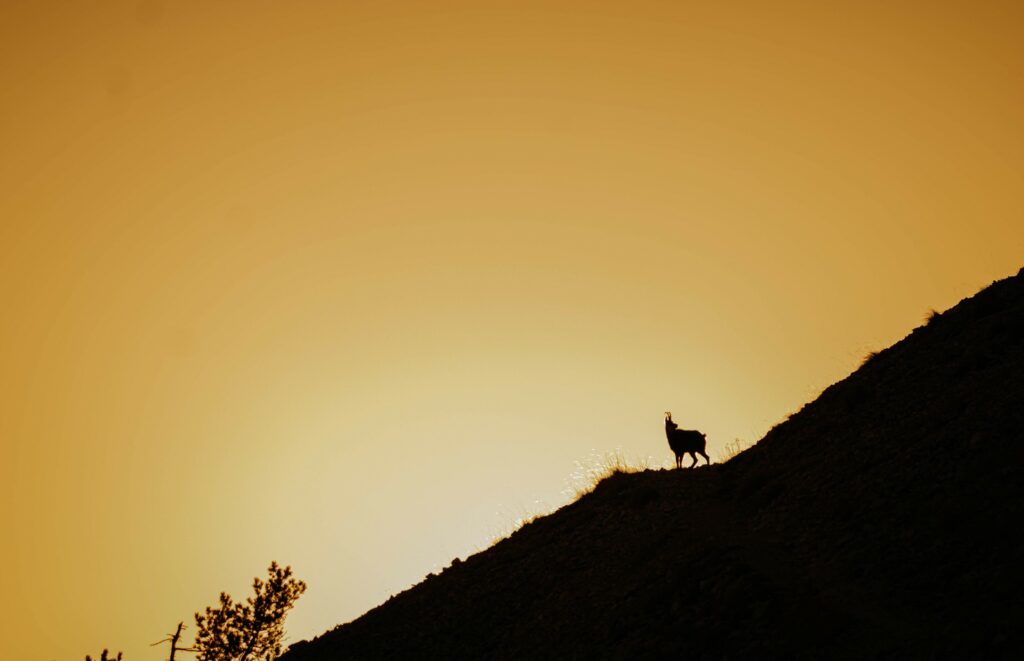
If you do wildlife photography, think about context too. A lone chamois on a slope, with the Ventoux ridges behind it, often tells more than a close-up with no surroundings.
Protecting Ventoux wildlife
Mont Ventoux is a very busy mountain. Between hiking, mountain biking, gravel riding and summer tourism, the pressure on wildlife keeps growing. The chamois adapt, but they remain sensitive to disturbance.
A few simple habits make a difference:
- Stay on marked routes.
- Don’t get too close, especially in spring.
- Share your sightings responsibly.
- Respect the animals’ resting areas.
Watching the Ventoux chamois is a privilege. The more respectful your approach, the better the experience for everyone, the animals included.
FAQ: Ventoux chamois
How many chamois are there on Mont Ventoux in 2026?
Recent estimates put the population at around 200 to 300 animals (Faune-PACA).
Can you see chamois all year round?
Yes, but spring and autumn are still the best seasons.
Which side of the mountain is best?
The north side is generally the best for watching them.
What time should you set off?
Daybreak and late afternoon are the best times.
What camera gear do you need?
A telephoto lens of at least 400 mm, with a tripod or monopod, is ideal.
Are there ibex on Mont Ventoux?
This article is about the chamois, which is well established on the massif. There are no ibex on Mont Ventoux, but there are mouflon.
What signs show that chamois are around?
Silhouettes on the slopes, groups resting, sometimes an alarm whistle and a quick escape. But if you get that far, it means you have disturbed them!
As a nature photographer based in the Vaucluse, I explore Mont Ventoux all year round, camera in hand. My wildlife photos are taken with respect for living things, without bait and with constant care to keep disturbance to a minimum.
Leave a Reply